(1).jpg)
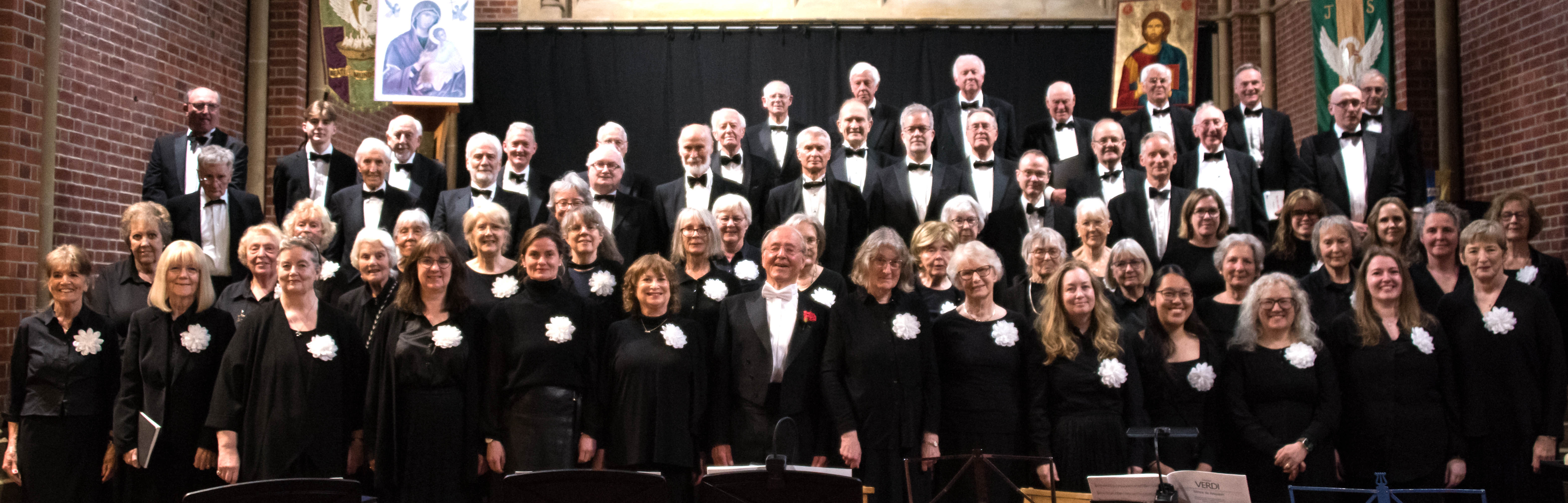
Performance by Ardingly and Forest Row Choral Societies,
Kidbrooke Park Singers and Sussex Chamber Orchestra.
Arguably Elgar’s finest creation, his stirring setting of Cardinal Newman’s great poem on the
transition of an Everyman figure from his last conscious moments and death to his salvation
was not only, as the composer explained, “ . . the best of me . . written . . out of my insidest
inside”! A few days before The Dream of Gerontius’ under-rehearsed first performance at the
1900 Birmingham Music Festival, he had revealed that its composition had preoccupied him
for we now know was 11% of his life: “The poem has been soaking in my mind for at least
eight years”. And despite the shortcomings of that near-fiasco, the audience and critics
recognised that they had witnessed a masterwork.
Even more remarkably, one and a quarter centuries later, in the appropriate setting of a
capacious Gothic school chapel built and dedicated not long before Elgar’s first creative
thoughts about setting Gerontius, a large and appreciative audience enjoyed a memorable
performance that did full justice to what Elgar regarded as “the best” of him. Its imaginative
conception, its more than adequate rehearsals, and its resultant fine execution by three
excellent conductor/singers, choirs, and soloists and a professional chamber orchestra, all
sensitive and faithful to what both poet and composer intended, realised in this age of AI
what both men had nurtured in their imagination, and written so skilfully, in the latter part of
Victoria’s reign. Rodney Earl Clarke’s comment to the audience after the performance was
well judged: that this successful co-operative venture might offer a fruitful and effective
precedent for the future of choral societies.
No performance by mere mortals, even at their best, in a finite space, of a masterpiece
whose characters include God Almighty and his angels can, of course, be entirely perfect.
During the orchestral fortissimos of Part 1 the operatically accomplished soloists’ words – all
three, throughout, models of clear diction - were occasionally overpowered by the
instruments not far behind them. And perhaps the lighting of the pulpit for the Priest and
Angel of the Agony (Rodney Earl Clarke) could have been brighter. Notwithstanding these
minor blemishes in making the best of the available space, this was a performance which
would have graced a Promenade concert, and which drew richly on the best traditions of
both sacred choral and orchestral music and grand opera. Elgar, and possibly Newman too,
would have been delighted.
If Elgar’s Gerontius was at the heart of his creative output, every good performance of it
must be centred on an excellent, suitably sized orchestra and choral forces, all working
smoothly, and with gusto or hushed sensitivity as the mood of the piece shifts.
The Sussex Chamber Orchestra, led by Jonathan Truscott, once again – as in last year’s
Verdi Requiem - made a first-rate, truly professional contribution, and likewise the organist,
David Moore.
The combination of the Ardingly Choral Society (conducted by Robert Hammersley) with the
Forest Row Choral Society (Rodney Earl Clarke) and Kidbooke Park Singers (Diane
Howard) was so well drilled - with each conductor taking turns to direct the musical forces –
that it was difficult to believe that they were not one choir. Yet Gerontius is far from easy for
even the finest professional choirs to perform well. In this respect the coveted gold-plated
spurs are to be won by convincingly bringing off the fiendishly difficult diction and timing of
the demons’ sneering chorus, or “sullen howl” as the Angel (Louise Callinan, mezzo
soprano) describes it to the fearful Soul of Gerontius (tenor Rory O’Connor). Achieving the
changing dynamics of the Choir of Angelicals’ Praise to the Holiest in the Height without
losing sight of the nature of that praise is scarcely a stroll in the park either. Both in these
test pieces and throughout, high standards were maintained and, importantly, the libretto
was delivered sympathetically and with appropriate emphasis.
Yet all this would have been commendable but wasted effort if the key characters in Elgar’s
and Newman’s natural and supernatural masterpieces were not sensitively and credibly
portrayed by the trio of soloists.
From his first fearful, imploring entry – “Jesu, Maria – I am close to death” - right through to
his final yet eternal words, delivered quietly, confidently, but reverentially, “Take me away,
and in the lowest deep / There let me be”, Rory O’Connor gave a reassuringly authentic
performance for the audience to empathise with. This, his first realisation of Gerontius /Soul,
drew assuredly on his boyhood musical training at the London Oratory School right through
to his later familiarity with opera and oratorio at the highest professional level. He sounded
and looked right for this part.
Some very distinguished basses and bass-baritones – among the best recently Bryn Terfel -
have appeared in and recorded Gerontius in what is often a twin role of Priest and Angel of
the Agony. Suitably powerful in appearance and vocal delivery, Rodney Earl Clarke brought
Part 1 to a telling end with his authoritative rendition of the Priest’s “Go forth upon thy
journey, Christian soul!”, and, as Angel of the Agony, his equally confident yet humble
petition to Jesus, “Jesu! Spare these souls which are so dear to Thee”, we all felt sure,
would not go unheard or unheeded.
In terms of the recent history of The Dream of Gerontius in Ardingly College Chapel, perhaps
the hardest solo act to follow from its predecessor there, on 1 April 2012, was Jane
Haughton’s impressive one as the Angel, “persuasively gentle, sympathetic but strong” in the
words of the review. In her fine angelic dress, Louise Callinan brought her extensive world-
wide solo operatic experience and a Sydney Opera House appearance in Handel’s Messiah
to inform her interpretation of Elgar’s guide over penal waters. Here was another angel,
sweet and strong, one whom the audience would have gladly followed past hell to divine
judgment, to complete the Dream team of three.
This was, in short, one of the finest performances ever witnessed at Ardingly College
Chapel, and one of Gerontius which would be difficult for any first-class gathering of choirs,
orchestra and soloists to better.
Review by: Melvyn Walmsley

To find out more about the choir and any performances:
contact Lorraine Doron, Secretary
© Copyright Ardingly Choral Society 2012 - 2026 | Registered Charity No 1123464